
When you pour a glass of tap water, you expect it to be clean, crisp, and refreshing. However, municipal water treatment often leaves behind a strong chemical taste of chlorine, while private wells can carry organic impurities and unpleasant odors. If you look at the most effective water purification systems on the market today, you will notice a common, humble ingredient at their core: charcoal.
But what does charcoal do in water filtration, and how does a substance born from fire turn muddy or chemical-laden water into a pristine refreshing drink?
In this comprehensive guide, we will dive deep into the fascinating science behind charcoal water filters, explore exactly what they remove, and reveal how advanced systems use this natural wonder to safeguard your family’s health.
The Science of Charcoal: Adsorption vs. Absorption
To understand what charcoal does in water filtration, we must first clear up a common linguistic and scientific confusion: the difference between absorption and adsorption.
- Absorption works like a sponge. When a sponge pulls in water, the liquid permeates the entire volume of the sponge, filling the spaces inside.
- Adsorption (with a "D") is a completely different chemical phenomenon. It is a surface-based process where fluid molecules adhere to a solid surface.
Regular charcoal from a backyard barbecue cannot filter water efficiently because its pores are already clogged with ash and chemical additives. Water filter systems utilize Activated Charcoal (also known as activated carbon). This material is created by heating organic substances high in carbon—such as coconut shells, wood, or peat—to extremely high temperatures in the absence of oxygen, followed by exposure to gases like steam.
This activation process "pops" open millions of microscopic pores, expanding the internal matrix of the carbon. The result is an incredibly porous material with a massive surface area. In fact, just one single gram of high-quality activated charcoal can have a surface area of over 500 to 1,500 square meters—roughly the size of several tennis courts!
As water flows over this activated surface, the carbon acts like a microscopic magnet. Carbon-based organic impurities and chemical contaminants are drawn to the charcoal's surface via Van der Waals forces, latching tightly into the micropores while letting clean water molecules pass through.
What Does Charcoal Do in Water Filtration? 5 Key Benefits
Activated charcoal is widely regarded as the workhorse of modern water treatment. Here is exactly what it achieves inside a high-quality filtration system:
1. Eliminates Bad Tastes and Foul Odors
Municipalities use chlorine or chloramines to disinfect water and kill harmful pathogens. While essential for public health, these chemicals leave behind a harsh, pool-like taste and smell. Activated charcoal is highly reactive with chlorine. When water passes through, a chemical reaction transforms free chlorine into harmless, tasteless chloride ions, immediately restoring a clean flavor profile to your drinking water.
2. Removes Volatile Organic Compounds (VOCs)
Rainwater washes pesticides, herbicides, and industrial solvents into our agricultural and municipal water tables. These are classified as Volatile Organic Compounds (VOCs). Because VOCs are carbon-based molecules, they possess a strong natural affinity for activated charcoal. The carbon pores trap these synthetic chemicals, preventing them from reaching your kitchen tap.
3. Reductions of Heavy Metals and Emerging Contaminants
Advanced, modern configurations of activated charcoal don't just stop at chemicals. When compressed into dense structures, they can trap heavy metals like lead, mercury, and copper. Furthermore, EPA research indicates that specialized carbon filtration can significantly reduce emerging, dangerous "forever chemicals" like PFAS and microplastics.
4. Retains Essential, Healthy Minerals
Unlike harsher purification methods that completely strip water of all its properties, standard charcoal filtration is selective. It binds tightly to synthetic chemicals and toxic organic compounds, but its chemical nature allows healthy, essential minerals like calcium, potassium, and magnesium to pass through freely. This ensures your water remains naturally alkaline and nutritionally beneficial.
5. Protects Downstream Appliances
By trapping sediments and chemical oxidizers early in the filtration cycle, charcoal blocks protect delicate components in secondary filtration stages, extending the overall lifespan of your household appliances.
Granular Carbon vs. Carbon Blocks: Which is Better?

When shopping for a charcoal filter, you will generally encounter two forms: Granular Activated Carbon (GAC) and Solid Carbon Blocks.
GAC filters contain loose, sand-like granules of carbon. While they offer decent water flow, the loose packing means water can sometimes create small paths of least resistance (channelling), bypassing the carbon altogether and leaving some contaminants unfiltered.
On the other hand, a Solid Carbon Block is formed by grinding activated carbon into a fine powder, mixing it with a food-grade binder, and compressing it under high pressure into a dense, solid core.
Because the water is forced to travel through a tight, uniform matrix, carbon blocks eliminate channelling entirely. They maximize "contact time" between the water and the carbon, allowing for vastly superior adsorption of micro-contaminants, heavy metals, and fine sediments.
Experience the Power of Advanced Gravity Filtration with AMwater
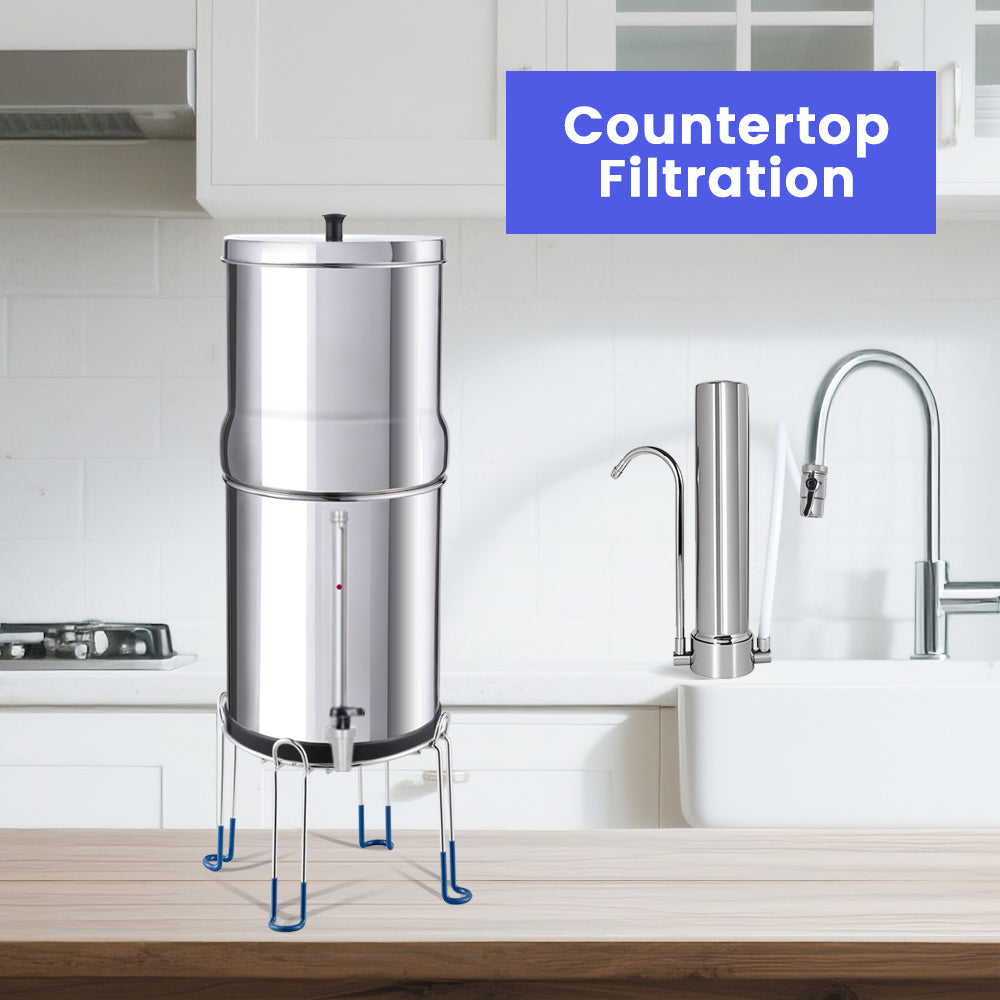
If you are looking for an eco-friendly, energy-efficient way to harness the absolute maximum potential of carbon block filtration at home, look no further than our engineering at AMwater.
We believe that accessing clean water shouldn't require complex plumbing or electrical hookups. That is why we developed the AMwater Carbon Block Gravity Filter.
Unlike standard pitcher filters that use loose granular charcoal, our gravity system utilizes an advanced, high-density carbon block core. By combining the natural physics of gravity with an ultra-dense carbon structure, this filter provides an uncompromised barrier against impurities. As water gently presses through the block, it undergoes meticulous adsorption, eliminating bad tastes, heavy metals, and toxic chemical residues while keeping vital minerals completely intact.
The AMwater gravity design ensures extended contact time, giving the activated charcoal maximum opportunity to grab onto even the most stubborn microscopic pollutants. It is the ultimate fusion of raw natural science and modern everyday convenience.
How Long Do Charcoal Water Filters Last?
While activated charcoal is incredibly powerful, it does not last forever. Over time, the millions of microscopic pores on the carbon surface will become completely filled and saturated with contaminants. When a filter reaches its maximum capacity, it can no longer adsorb new impurities.
Using an exhausted filter means water will pass through completely untreated. For optimal performance, the lifespan of your filter depends on your household's daily usage and the quality of your incoming water. Systems like the AMwater Carbon Block Gravity Filter are engineered for long-term efficiency, but replacing the elements according to the recommended maintenance cycle guarantees that every sip you take remains as pure as the first.
Conclusion: A Time-Tested Solution for Modern Purity
So, what does charcoal do in water filtration? It serves as nature's ultimate purifier. By leveraging the elegant chemical process of adsorption, activated charcoal masterfully strips away harsh disinfectant chemicals, dangerous industrial VOCs, and unpleasant tastes, leaving behind clean, healthy, and pristine drinking water.
Investing in the right filtration technology is an investment in your long-term wellness. Explore how AMwater elevates traditional carbon purification to new heights, and bring the pure, crisp taste of premium gravity-filtered water into your home today.

Leave a comment
This site is protected by hCaptcha and the hCaptcha Privacy Policy and Terms of Service apply.